

Free text
Summary and key ideas
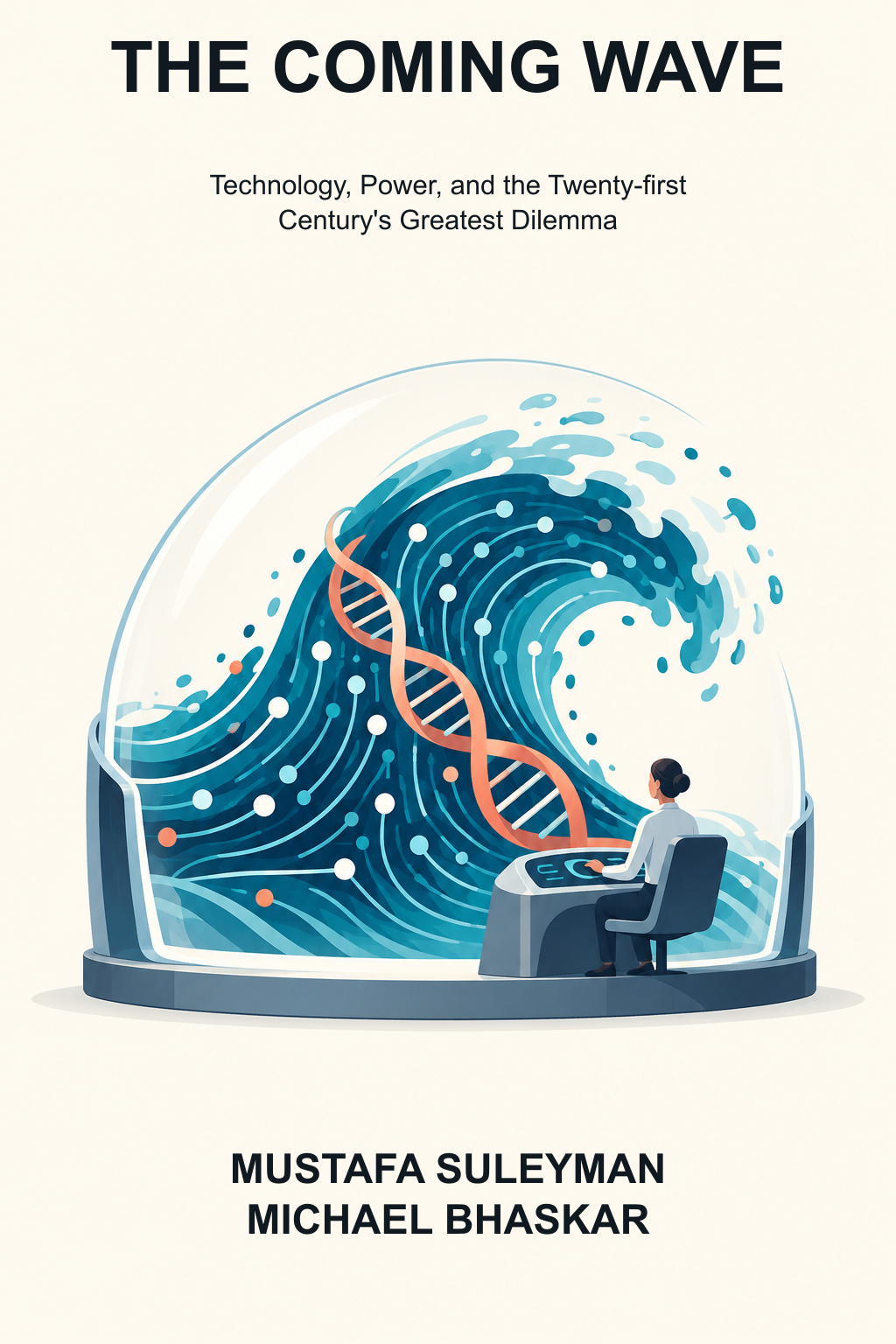
Book summary prepared by ReWio. Original book author: Mustafa Suleyman, Michael Bhaskar.
Introduction
The Coming Wave is a book about a shift in capability. Mustafa Suleyman and Michael Bhaskar argue that the most important feature of advanced technology is not merely that it makes familiar tasks faster or more convenient. It expands what individuals, firms, and states can actually do. That expansion can improve health, scientific discovery, education, productivity, and environmental problem-solving. It can also widen the reach of fraud, coercion, disruption, and error.
Their concern is not that every new tool is harmful. Nor do they treat progress as a single villain with a predetermined ending. Their argument is more demanding: powerful technologies spread because they solve real problems, generate profits, confer strategic advantages, and invite imitation. Once a capability is useful, others adapt it to goals the original inventors may never have intended. Inventors cannot dictate every downstream use, but the authors maintain that they still bear responsibility for what they build, release, enable, and normalize.
The book’s focus is chiefly the interaction of artificial intelligence and synthetic biology. AI can help interpret information, discover patterns, design options, and coordinate workflows. Biological technologies can increasingly turn knowledge into interventions in living systems. The combination matters because faster information processing may accelerate biological research and design. But a balanced reading needs an important qualification: computation does not erase laboratory constraints, physical materials, scientific uncertainty, or the need for skilled and responsible practice. A model producing a plausible suggestion is not the same as a safe, validated result in the world.
The authors frame this moment as a political and institutional challenge as much as a technical one. Their question is whether humanity can capture extraordinary benefits while preventing severe harms. They call the needed capacity “containment.” This is not a claim that a perfect box can permanently seal away powerful knowledge. It is an aspiration to retain the ability to monitor, constrain, redirect, and, where justified, halt dangerous development or deployment.
This summary treats their argument as a provocative framework, not as a proven prophecy. Some of their forecasts are necessarily uncertain. The useful task is to take their questions seriously without assuming that artificial intelligence is conscious, that a single future is inevitable, or that every alarming scenario will occur.
Capability, Not Just Convenience
A central idea in the book is that technology redistributes power. Power here means the ability to achieve an objective: to organize, persuade, design, analyze, coordinate, or act at scale. Earlier digital tools made it easier to publish and exchange information. The authors argue that newer systems increasingly assist with planning and execution. That distinction changes the stakes.
An AI system that summarizes documents or proposes a schedule may be helpful but limited. A system connected to accounts, software, machines, or organizational processes can potentially carry out a chain of actions. This is why it is essential to distinguish recommendation from authorized execution. A tool can recommend a refund, for example; authorizing it to send money is a separate governance decision. It can draft a message; granting it permission to transmit that message to a client is another threshold. Capability grows sharply when systems receive access, permissions, and autonomy.
The authors expect powerful tools to proliferate because usefulness creates incentives. Businesses seek efficiency and new products. Governments seek resilience and strategic advantage. Researchers seek discoveries. Ordinary people seek assistance. This dynamic means that asking a single inventor to “be responsible” is necessary but insufficient. Decisions are distributed across suppliers, deployers, users, investors, regulators, and institutions.
Additional practical analysis: competence is not trustworthiness. A system can produce impressive work on many occasions and still be unsuitable for a consequential role if its errors are difficult to detect, its reasoning cannot be meaningfully reviewed, or responsibility disappears when harm occurs. Reliability is contextual. A typo in an internal draft is unlike a wrong action involving a person’s livelihood, safety, or legal status.
Consider an illustration, not an anecdote from the book. A small company uses an assistant to draft replies to customers. That is relatively easy to supervise. If the company later permits it to send messages, approve refunds, or alter subscriptions on its own, it should establish clear spending limits, escalation rules, logs, and a way to reverse mistakes. The relevant question is not whether automation is good or bad. It is whether authority matches demonstrated reliability and whether an accountable person remains responsible.
This approach avoids two errors. One is treating every automated feature as an existential threat. The other is treating an apparently minor permission change as harmless. The authors’ broad warning is that societies should watch how capability accumulates—not just how polished a technology appears.
Why AI and Biology Reinforce Each Other
The authors place artificial intelligence and synthetic biology at the center of the coming wave because they see them as mutually reinforcing general-purpose capabilities. AI works primarily with information: it can sort, predict, generate, simulate, and assist decision-making. Biology concerns living systems and the ability to understand or alter them. In the authors’ view, better computational tools can speed parts of biological research, while biological knowledge opens new practical possibilities in medicine, agriculture, materials, and beyond.
That combination supports genuine hope. Computational assistance may help researchers identify promising questions, organize large bodies of evidence, and shorten parts of a discovery process. Used carefully, it could make useful expertise more available. A teacher might use an AI tool to generate varied practice questions, adapt explanations for different reading levels, or help prepare a lesson. Yet the teacher still needs to verify accuracy, protect student privacy, and decide whether a generated exercise teaches the intended skill. Assistance is not abdication.
The authors are equally concerned that broadly useful knowledge can have harmful applications. Their point is not that biological research should stop, or that every person who learns more biology is dangerous. It is that wider access to powerful design and planning tools may lower some barriers for irresponsible or malicious actors. The exact scale and timing of such risks remain uncertain, and physical laboratory requirements still matter. Nonetheless, the possibility changes the standard for safety: it is not enough to evaluate whether a tool benefits conscientious users; designers must also consider misuse and failure.
Different dangers call for different protections. Preventing accidents is not identical to preventing intentional abuse. Accident prevention may involve training, testing, checklists, clear interfaces, and fail-safe defaults. Deliberate misuse may require access restrictions, monitoring of high-risk capabilities, investigation procedures, and consequences for violations. Combining these into one vague idea of “safety” can leave gaps.
The book’s key lesson is therefore not that AI magically solves biology or that biology makes catastrophe unavoidable. It is that two fast-moving fields can compound one another’s effects. Responsible governance should look at the combined system: what a tool enables, who can use it, what real-world resources are still needed, and what safeguards apply before a capability becomes widely available.
The Features That Make Control Harder
Suleyman and Bhaskar identify several tendencies that can make a technology difficult to manage. They emphasize rapid improvement, broad reusability, asymmetric impact, and growing autonomy. These are best understood as questions for analysis, not as universal laws. Not every AI system is general-purpose. Not every biological technique is easily accessible. Not every automated process deserves the same level of concern.
First, rapidly evolving technologies can outpace rules, training, and organizational adaptation. A policy designed for last year’s system may not fit a system that is cheaper, more capable, or embedded in new workflows. Second, a general-purpose tool can be adapted to many tasks. This produces enormous value, but it also makes it harder to anticipate every use. A narrowly designed system used for one defined purpose can sometimes be tested and governed more directly than a flexible tool that travels across domains.
Third, asymmetric impact means that a relatively small actor may sometimes have effects far beyond their resources. Digital systems can operate quickly and at scale; a small error, deception campaign, or automated decision can reach many people before anyone notices. Fourth, autonomy changes the operational picture. A system that waits for a person at each consequential step is different from one that selects goals, uses tools, and continues acting across a sequence of tasks.
The critical distinction is between a tool’s apparent intelligence and its operational authority. A system might be excellent at drafting a plan but poor at coping with exceptions, conflicting values, or missing context. A system that is competent in a benchmark environment is not thereby trustworthy in a messy institution. Before authority expands, organizations should ask: What can this system do? What is it allowed to do? Who verifies its actions? What happens when it fails? Can we trace and reverse its effects?
Illustration: a public-service tool might rank applications or identify cases for review. A responsible design would not turn that ranking into an unchallengeable decision. It would provide understandable reasons, preserve an appeal route, identify the accountable office, and test whether errors fall unfairly on particular groups. This is not friction for its own sake. It is a way to preserve legitimacy when decisions affect real people.
The authors’ framework encourages proportionality. Systems with limited scope, constrained permissions, and readily reversible outcomes require a different response from systems that affect critical infrastructure or can act broadly without review. The goal is neither panic nor passivity. It is to connect safeguards to the actual properties and consequences of a capability.
Proliferation Alongside Concentration
One of the book’s most useful tensions is that technological power can spread outward while key infrastructure remains concentrated. Many people may gain access to strong tools through applications, APIs, and services. At the same time, building the largest systems can depend on expensive chips, data centers, specialized talent, capital, and supply chains. Both trends can be true at once.
This matters because popular arguments often choose only one side. Some say advanced technology will inevitably decentralize power because tools reach more users. Others say it will inevitably centralize power because only large institutions can afford the infrastructure. The authors’ perspective suggests a more complicated landscape: access may broaden, while leverage over foundational systems, distribution channels, and technical standards may remain in relatively few hands.
This creates governance opportunities and hazards. Concentrated compute infrastructure can be a practical point for oversight. Operators of large data centers and high-end computing resources may be easier to identify than every eventual user of a digital tool. The authors propose that such choke points could support licensing, reporting, monitoring, and safety requirements.
But this is a proposal, not a complete answer. Controls at infrastructure layers can entrench incumbents, disadvantage smaller researchers, and give governments or dominant firms excessive influence over who may innovate. They can also miss lower-compute tools and capabilities that diffuse through other routes. Any governance system that uses leverage points must therefore face hard questions: Who writes the criteria? Is there an independent review process? Can a smaller organization appeal a mistaken denial? Are obligations transparent and proportionate? Does regulation protect the public without merely protecting established players?
Additional practical analysis: fair governance needs both prevention and access. A rule that prevents a serious risk may be justified, but legitimacy depends on explaining the rule, allowing evidence-based challenge, and checking whether its burdens fall unevenly. Otherwise, containment can become a respectable label for arbitrary exclusion.
The book does not resolve this tension, and perhaps no simple formula can. Its value lies in making the trade-off visible. A future in which capability is widely distributed does not automatically become democratic. A future in which infrastructure is controlled does not automatically become safe. Institutions must examine ownership, accountability, competition, and public benefit together.
Institutions Under Pressure
The authors worry that institutions may struggle to adapt as quickly as the technologies they must oversee. Schools, courts, agencies, companies, news organizations, and democratic systems depend partly on trust: people need to know who made a decision, what evidence mattered, and where to seek correction. Fast, scalable technologies can put these arrangements under pressure through error, impersonation, manipulation, opaque decision-making, or sudden changes in economic power.
This does not mean institutions are helpless or obsolete. It means that institutional capacity matters. Rules must be understandable, expertise must be available, and procedures must be able to learn from new evidence. A government or organization that only responds after damage has occurred may repeatedly regulate yesterday’s problem. Yet a system that tries to predict and prohibit every possible future use may become rigid, intrusive, and ineffective.
The book rejects easy extremes. Universal bans would forgo genuine benefits and would be difficult to enforce globally. Total surveillance might promise control while undermining civil liberties, public trust, and the open conditions necessary for science and democracy. Neither path is painless. Good governance has to recognize competing values rather than claim that safety eliminates every cost.
A more practical model is staged deployment. Illustration: before a system is used across an entire organization, it can be tested in a limited setting with clear performance measures, human supervision, incident reporting, and a rollback plan. If measured failures exceed an agreed threshold, deployment pauses or reverses. This does not guarantee safety, but it creates feedback before mistakes become entrenched.
Public trust also requires contestability. When an automated recommendation influences a consequential decision, affected people need a meaningful explanation, a route to challenge an outcome, and clarity about which human institution is accountable. “The system said so” is not a defensible final answer.
Suleyman calls the tendency to dismiss uncomfortable technological risks “pessimism aversion.” This is his label, not a clinical diagnosis, and it does not prove that every pessimistic forecast is correct. Its strongest meaning is modest: denial can be as intellectually lazy as sensationalism. Responsible preparation requires looking at plausible downside risks, testing claims, and revising beliefs when evidence changes.
Containment as a Continuing Practice
The book’s proposed answer is containment: a layered ability to monitor, constrain, and, when necessary, stop the development or deployment of dangerous technologies. The authors do not present it as a one-time invention or a magic guarantee. In fact, they stress the tension that containment may seem extraordinarily difficult while still being necessary to pursue.
A layered approach matters because no single control is reliable enough by itself. Technical evaluations can probe systems for failures and harmful behavior before release. Restricted permissions can prevent a tool from taking consequential actions without approval. Human authorization can be required at key points. Audit logs can make actions reviewable. Independent scrutiny can challenge company claims. Liability and incentives can make safety failures costly rather than externalized onto the public. Credible standards can clarify expectations, and international cooperation can reduce the temptation to race toward riskier deployment.
These measures serve different purposes. Evaluation seeks to discover weaknesses. Access control limits what a system can do. Auditing supports accountability after the fact. Liability changes incentives. International agreements address the problem that one actor’s restraint may be exploited by another actor seeking advantage. Confusing these layers can create false reassurance: a system may be well tested but poorly governed, or tightly restricted by one company while still copied elsewhere.
Competition is one of the authors’ hardest problems. Firms may fear being overtaken. States may fear strategic disadvantage. Security concerns may make countries reluctant to share information or slow development. This means voluntary restraint by a single actor can be fragile. Collective coordination is not guaranteed, but the book argues that it is essential precisely because unilateral solutions are vulnerable.
The authors’ proposals deserve scrutiny. Who decides what counts as an unacceptable risk? How transparent are evaluations? What information must remain confidential, and what must be publicly contestable? How are regulators kept technically capable and politically accountable? How can rules be updated when they fail? These questions are not objections from outside the containment project; they are requirements for making it legitimate.
Containment should therefore be understood as ongoing governance under uncertainty. Its success would not mean that all risk disappears. It would mean that societies retain enough visibility, authority, and adaptability to prevent avoidable harm while preserving room for beneficial innovation.
Final Summary
The Coming Wave argues that advanced technologies should be judged by the capabilities they distribute, not merely by the conveniences they offer. Suleyman and Bhaskar see AI and synthetic biology as particularly significant because they may accelerate discovery, amplify organizational power, and lower barriers to sophisticated action. Their warning is paired with real optimism: the same tools could support major public benefits.
Their central challenge is containment. Not permanent technological lockdown, not unquestioning acceleration, and not the fantasy that regulation alone settles everything. Instead, they call for overlapping technical, institutional, legal, economic, and international measures that keep humans able to supervise, constrain, and, where needed, stop harmful uses.
The book is strongest when it forces readers to ask operational questions. What is a system permitted to do? Who is accountable for its failure? Where are the irreversible thresholds? Who receives new power, and who bears new risks? Its predictions should not be treated as deadlines or certainties, and its authors’ industry perspective is worth keeping in view. Still, their core challenge remains valuable: progress is not only about inventing powerful tools. It is about building institutions mature enough to govern their power.