

Free text
Summary and key ideas
Book summary prepared by ReWio. Original book author: Scott Galloway.
Introduction
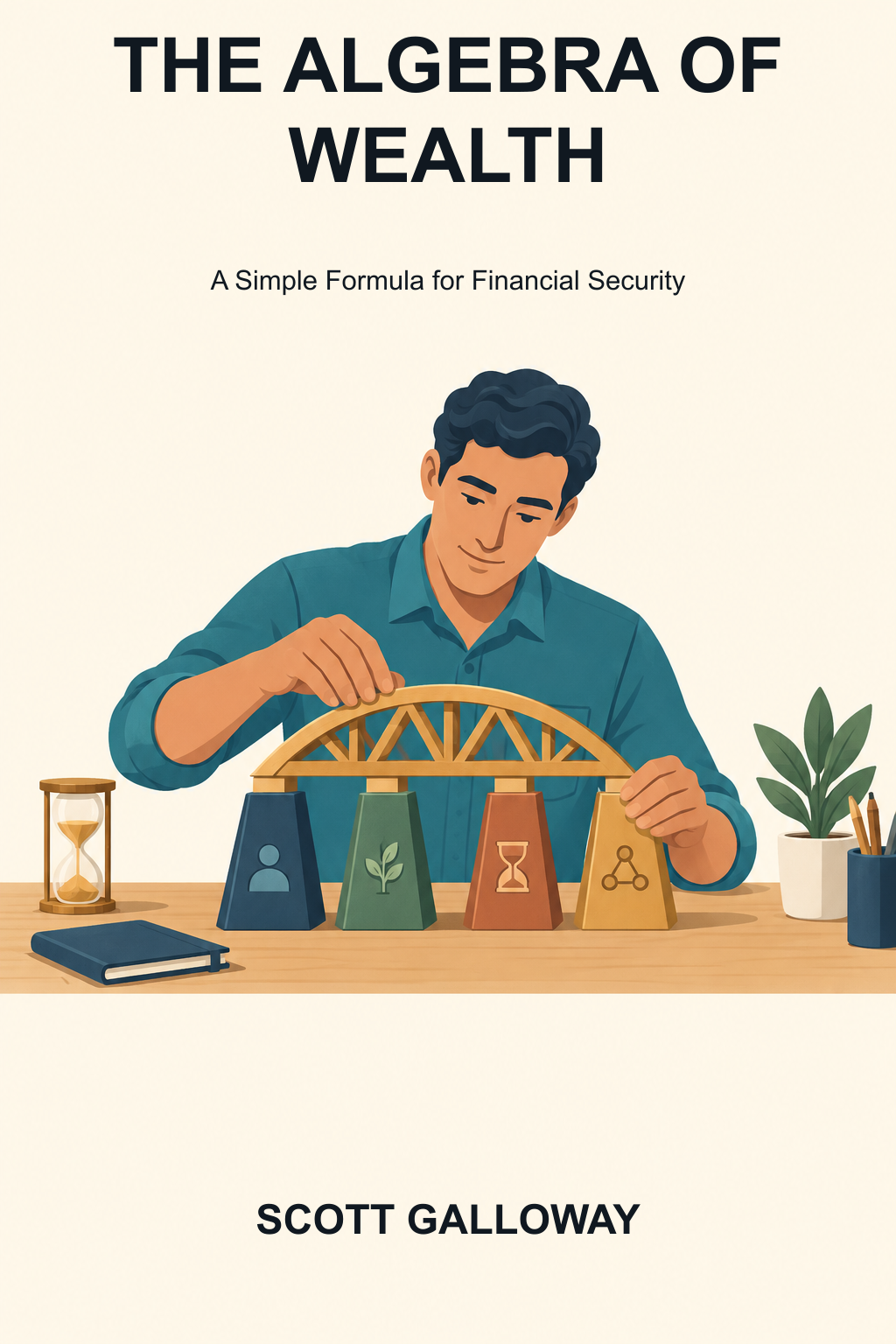
The Algebra of Wealth is Scott Galloway’s 2024 argument that financial security is built through a wider life strategy, not through investment selection alone. The American edition’s subtitle, A Simple Formula for Financial Security, captures the book’s ambition, but “formula” should be read as a framework rather than a promise. Galloway organizes his perspective around four interacting influences: focus, stoicism, time, and diversification.
In this summary, security means having more viable choices when life becomes difficult or when opportunity appears. It can mean being able to endure a job transition, decline a damaging workplace, meet an obligation, recover from an error, or make room for work that matters. It does not necessarily mean prestige, luxury, or reaching one universal net-worth number. A person can earn a great deal and remain financially fragile if fixed commitments rise just as quickly. Another person may have modest means yet create meaningful resilience through lower vulnerability, useful skills, supportive relationships, and thoughtful planning.
Galloway’s strongest contribution is this whole-person lens. He pushes the reader to see career, character, and investing as connected. Better earnings can create room to save; restraint can preserve that room; time can magnify repeated good decisions; and diversification can keep one reversal from becoming catastrophic. The parts reinforce one another, but they can also break down together.
That last point matters. The book’s framework is persuasive as a direction of travel, not as a scientific law. Effort does not erase disability, discrimination, family care, housing costs, labor-market weakness, war, illness, or unequal access to education and capital. Luck and institutions shape outcomes alongside behavior. The useful question is therefore not, “Can I guarantee wealth?” It is, “Which choices can improve my odds, reduce needless fragility, and expand my future options?”
Focus Before Passion
Galloway challenges the popular instruction to simply follow passion. His alternative is to notice where one’s abilities can become valuable to other people and organizations, then develop those abilities seriously. This is not an argument for choosing work one hates. It is an argument that enjoyment alone is a weak career compass when the work does not solve a real problem, reward competence, or offer a path to improvement.
Focus, in this sense, is an active process. A person explores several possible directions, seeks honest feedback, observes what they learn quickly, and looks for evidence that others will pay for the result. Evidence may include completed projects, a portfolio, improved performance, references, credentials where they truly matter, or repeated trust from clients and colleagues. Talent is not merely something felt internally. It becomes economically useful when it meets opportunity, practice, demand, and visibility.
Consider a hypothetical worker who wants to leave an administrative job for data analysis. Rather than making a dramatic exit based on enthusiasm alone, she could preserve her income while taking an introductory course, completing a small project for a community group, asking practitioners for feedback, and seeing whether she enjoys the real work enough to persist. This does not remove risk, but it replaces fantasy with information.
The limitation is equally important. Market demand is not a moral ranking of people. Some socially essential jobs are underpaid; access to exploration is uneven; and health or caring responsibilities can limit experimentation. Meaningful work, decent conditions, and physical and mental health still matter. Galloway’s challenge to passion slogans is useful when it encourages grounded skill-building. It becomes too blunt if it suggests that talent reliably overcomes structural barriers or that income is the only measure of a worthwhile vocation.
Character as Financial Infrastructure
The book uses stoicism in a practical, everyday sense. Galloway’s claim is that durable character comes less from good intentions than from repeated conduct: doing what one said one would do, pausing before an impulsive purchase, finishing difficult work, and acting fairly when no immediate reward is visible. The underlying distinction is between what a person can influence—their response, preparation, and behavior—and what they cannot fully control, such as markets, layoffs, or other people’s judgments.
This version of stoicism should not be confused with emotional suppression. Fear, grief, anger, and joy are not failures. Nor should restraint become a moral explanation for poverty. Material hardship often reflects forces much larger than individual choices. The practical value of stoicism is narrower: it can help someone avoid adding self-inflicted instability to the unavoidable instability of life.
Galloway links this to consumer temptation. Higher income does not automatically produce security when every raise is absorbed by a more expensive lifestyle. A sustainable margin—some gap between resources and commitments—creates breathing room. Yet restraint should not mean neglecting essentials, health, rest, generosity, or all pleasure. The point is conscious trade-offs, not performative deprivation.
A hypothetical household receives a raise and immediately considers a bigger apartment, a newer car, and more expensive routines. A stoic question is not “What purchase proves success?” It is “Which change genuinely supports our priorities, and which one locks us into costs that shrink our choices later?” That question invites courage to disappoint social expectations, wisdom about consequences, fairness toward partners or dependents, and moderation in consumption.
Reliability also has a social dimension. People tend to want to work with those who prepare, communicate honestly, keep commitments, and share credit. Trust can take years to establish and moments to damage. Still, relationships should never be treated as transactions or as a reason to remain in an unsafe partnership, exploitative job, or harmful community.
Time and the Power of Repetition
Time is the quiet multiplier in Galloway’s framework. Skills deepen when practice continues beyond the exciting beginner stage. Reputation develops through many small encounters. Savings, where available, can accumulate from repeated contributions rather than one heroic decision. The broader lesson is that a modest process maintained for years may matter more than a burst of motivation followed by abandonment.
This is easy to say and difficult to live. Long horizons ask us to value benefits that are not yet visible while dealing with bills, fatigue, caregiving, and uncertainty today. The practical response is to make the next action small enough to be repeatable. A person does not need to wait for a windfall, a perfect plan, or a new identity.
For example, in a hypothetical case, someone hoping to improve their financial position might choose one feasible weekly practice: review upcoming obligations, learn a job-relevant skill for a scheduled hour, or automate a modest transfer only after protecting essential bills. The practice itself is not magical. Its benefit is that it turns vague aspiration into a system that can survive ordinary weeks.
Time also requires intellectual humility. Financial returns are uncertain, inflation and fees can erode results, losses occur, and an emergency can interrupt even excellent plans. No responsible application of compounding should promise a fixed outcome or a precise date when someone will be secure. Time amplifies both good and bad arrangements: high-cost debt, unsustainable work, and neglected health can compound too.
The deeper implication is that patience is not passivity. It is the willingness to keep improving what can be controlled while revising when reality changes. A long horizon works best alongside periodic review: Are the goal, the costs, the risks, and the person’s capacity still what they were when the plan began?
Concentrate Your Work, Diversify Your Risks
A central tension in the book is worth separating carefully. Galloway encourages focus in a career while advocating diversification in financial exposure. These are not contradictory. A person may concentrate effort on becoming excellent at one profession because mastery often rewards depth. But that same person need not assume they can forecast the future of one employer, industry, private venture, or asset with equal confidence.
The distinction is especially important when income and investments depend on the same economic story. An employee whose job, bonus, and savings are all tied to one company may face several losses at once if that company struggles. A founder may have both current income and accumulated wealth bound to one business. Diversification cannot eliminate loss, but it can reduce the danger that a single failure controls every part of life.
Consider a hypothetical small-business owner whose venture is thriving. She may rightly stay focused on serving customers and improving operations. At the same time, she can recognize that her future income, identity, and savings are already highly concentrated in that one enterprise. The analytical lesson is not to abandon ambition. It is to notice correlated risks before a downturn forces the issue.
Diversification also has boundaries. It does not solve a near-term cash need, make volatile holdings safe, or replace an emergency plan. Assets may fall together, be inaccessible when needed, or carry costs that matter. Decisions must account for time horizon, debt, dependents, tax rules, legal conditions, and the ability to bear a loss. That is why broad principles are not personal investment prescriptions.
Galloway’s perspective is valuable because it counters the romance of the single brilliant bet. Its limitation is that diversification alone cannot compensate for low income, exclusion from asset ownership, or a lack of basic security. Risk reduction is helpful, but it is not a substitute for fairer opportunity or adequate social support.
Luck, Relationships, and Enough
Galloway openly emphasizes luck: birth circumstances, education, timing, mentors, market conditions, and access to opportunity interact with effort. This is a necessary corrective to stories that convert success into proof of superior character. Good results can contain skill and luck; setbacks can contain mistakes and bad luck. Recognizing both encourages humility after success and compassion after failure.
Relationships belong in this picture, not because wealthy people are automatically kinder or because any relationship produces money, but because human beings accomplish more through trustworthy collaboration than in isolation. Ethical cooperation can create information, support, referrals, practical help, and emotional steadiness. Nontransactional generosity matters precisely because a relationship becomes hollow when every interaction is a calculation of return.
The book also presses toward the question of enough. Status competition has no natural finish line: there is always a more impressive home, title, holiday, or possession. If money is only a scoreboard, the target keeps moving. A more durable definition asks what resources are needed for essential spending, responsibilities, health, time with people who matter, and a meaningful degree of choice.
A hypothetical family could review its basic needs, current commitments, desired time together, and long-term responsibilities. It might decide that “enough” means a stable home, manageable obligations, room for rest, and the ability to support a child or aging parent—not matching the visible consumption of peers. That definition can change as circumstances change, but writing it down makes comparison less powerful.
This is not an argument to lower ambition or romanticize scarcity. Money can reduce real suffering and expand freedom. It is an argument to decide what freedom is for. Wealth is most useful when it serves a life rather than becoming the only evidence that life is going well.
Final Summary
The Algebra of Wealth offers a compact way to think about financial security: build valuable capability, practice restraint and reliability, allow good habits time to work, and avoid exposing your entire future to one bet. Galloway’s framework is broader than a standard investing guide because it starts with the person’s work and behavior, then connects them to money, relationships, and purpose.
Its most practical insight may be that security is cumulative. Career focus can raise earning potential, but only if matched with opportunity and health. Restraint can preserve a margin, but only if basic needs are realistically met. Time can magnify steady effort, but it cannot guarantee investment returns. Diversification can soften concentrated risk, but it cannot remove uncertainty. Each component is useful; none is sufficient by itself.
The critical addition is to keep agency and circumstance in the same frame. People should take responsibility for choices they can influence without pretending that every starting point is equal. A layoff, illness, discrimination, caregiving burden, inaccessible education, or weak local labor market is not evidence of defective character. Conversely, luck should not become an excuse for surrendering all initiative. The mature position is to work deliberately, ask for help, support better institutions, and remain honest about uncertainty.
For ordinary life, the framework can become a recurring set of questions. What skill am I testing or strengthening? Which commitment is increasing fragility? What small action can I repeat? Where am I overdependent on one source of income, one asset, or one person? What does enough look like for this season of life? The answers will differ across households and countries.
Finally, advice has costs, conflicts, and limits. Important decisions may require a qualified local professional who understands the person’s legal, tax, debt, family, and health circumstances. The book is best used as a prompt for clearer thinking—not as a substitute for judgment, solidarity, or a guaranteed route to wealth.