

Free text
Summary and key ideas
Book summary prepared by ReWio. Original book author: Bill Bryson.
Introduction
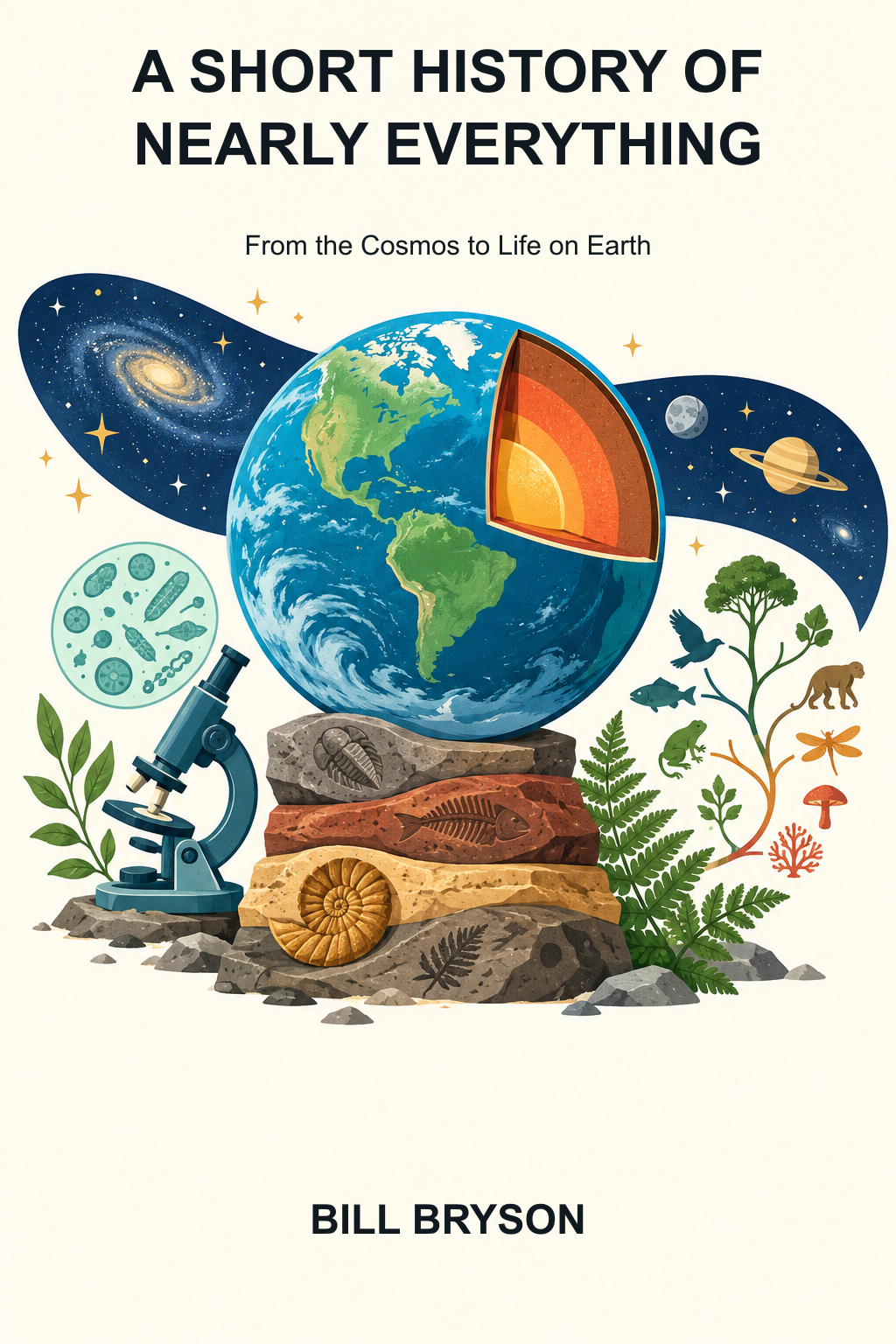
A Short History of Nearly Everything is an unusually ambitious invitation: look outward to the universe, downward into the Earth, inward to the cell, and backward through the immense history that links them. Bill Bryson’s original book appeared in 2003, so particular measurements, classifications, and active debates have inevitably moved on. This ReWio guide keeps the book’s lasting value: its curiosity about how scientific knowledge is assembled. It is a representative introduction to a long work, not a replacement for every one of its thirty chapters, and it does not address later revisions.
The most useful question in science is often not “What is the answer?” but “How could anyone know that?” A claim earns confidence when measurements are clear, observations can be checked, alternative explanations are considered, and independent lines of evidence converge. Confidence is not the same as absolute certainty. Some conclusions are extremely well supported; others are provisional because the evidence is limited or because several models still fit it.
Suppose you discover a mysterious mark on a pavement. One explanation says it came from dripping water; another says a bicycle tire caused it. Instead of choosing by intuition, ask what each explanation predicts. Water might leave a pattern related to slope, a stain, or a nearby source. A tire might leave a repeated track, rubber residue, and similar marks leading away. The point is not that every mystery is easy. It is that evidence can discriminate. This habit scales up. It helps scientists reconstruct ancient climates from ice, continental motion from rocks and seafloor patterns, and cosmic history from light.
Bryson also stresses, in his own way, that science is done by people. Researchers can be imaginative, generous, stubborn, competitive, mistaken, or overly attached to recognition. Discoveries are therefore rarely the achievement of a solitary hero working in a vacuum. Instruments, technicians, field crews, prior theories, critics, archives, funding, and rival teams all matter. Human imperfections are a reason to value transparent methods, replication, and correction—not a reason to conclude that every view is equally good.
Reading the Universe Through Light
Cosmic history begins with a scale problem. Our ordinary intuitions were built for rooms, roads, and lifetimes, not for distances where light itself takes a long time to arrive. When we observe a distant object, we receive old light. Astronomy is therefore a kind of historical investigation: the farther the source, the farther back in its visible past we are looking.
A deliberately non-scale sketch can help. Draw the Earth as a dot on one side of a page and a faraway galaxy as another dot on the other side. Now draw an atom beside the Earth dot. The picture is wildly misleading if treated as a map: the size relationships and distance relationships cannot all fit one useful scale. Still, it makes one important point. The same universe contains structures whose relevant sizes differ so dramatically that we must use models, mathematics, and instruments rather than visual instinct alone.
The broad modern account holds that space has expanded from an early hot, dense state. It is not best imagined as a conventional bomb exploding from a central point into an already empty surrounding room. In the scientific model, expansion concerns the changing distances within space itself. That statement does not settle every philosophical question about origins, nor does it mean scientists directly observed a first instant of creation.
Why take this model seriously? Not because it is a satisfying story by itself, but because several observations connect to it. Light from distant galaxies shows patterns consistent with expansion. The universe contains a faint microwave background, interpreted as relic radiation from an early hot phase after the universe became transparent enough for light to travel freely. The observed distribution of light elements also fits the general framework. Each strand has its own technical limits, but together they are more persuasive than any single dramatic image.
The responsible lesson is twofold. First, evidence from the sky is evidence from the past. Second, a strong explanation is one that coordinates many observations and risks being wrong. If later measurements repeatedly clashed with its predictions, scientists would need to modify or replace it. That capacity for revision is a strength, not an embarrassment.
Matter Is Not a Tiny Solar System
Next, Bryson takes us from cosmic distances to atomic scales. The rocks beneath our feet, the air around us, a leaf, and a human body all depend on atoms and the ways atoms join, exchange energy, and interact. This does not make living things “merely” matter. It means that life’s remarkable organization operates through physical and chemical processes rather than outside them.
Popular pictures of atoms can mislead. An atom is not literally a miniature solar system with neat little planets circling a central sun. That image is a simplified teaching device. Modern descriptions use quantum physics to describe regions where electrons are likely to be found and the rules governing their energy. We can understand the central lesson without mastering the equations: the microscopic world does not behave exactly like enlarged everyday objects.
You may hear that atoms are mostly empty space. That phrase can be useful if it refers to the enormous difference between nuclear and atomic scales, but it can become nonsense if taken to mean that a hand ought to pass through a table. It does not. The electrical interactions and quantum rules involving the particles in your hand and the particles in the table produce the solidity you experience. “Mostly empty” is a statement about scale and structure, not permission for matter to ignore matter.
This matters because science often progresses by replacing a useful but incomplete picture with a better one. We should not cling to a classroom analogy after it has done its job. Ask: where does this model work, and where does it stop? A map is not a landscape; an atom diagram is not an atom. Models can be extraordinarily powerful precisely because they state their scope.
The same ordinary ingredients can form granite, seawater, bacteria, trees, and brains because arrangement matters. Chemistry is not a miscellaneous collection of substances. It is a rule-governed set of interactions with consequences at larger scales. That bridge—from particles to materials to living systems—is one reason the history of nearly everything can be told as a connected story.
Time Written in Stone
Deep time is difficult not because it is vague but because it is so far beyond personal experience. A century can feel long to us; geological processes can build, bury, deform, erode, and recycle landscapes across intervals for which human memory is no guide. Geology made Earth history intelligible by turning rocks into evidence rather than scenery.
Relative dating asks which event came first. In an undisturbed sequence of sedimentary layers, lower layers were generally laid down before layers above them. Fossils can help compare strata from different places, especially when the same distinctive kinds occur in a consistent sequence. But relative order is not a calendar. A rock may be older than the layer above it without revealing its numerical age.
Absolute dating uses a different kind of clock. Some radioactive isotopes change into other isotopes at predictable rates. If scientists know how a mineral incorporated elements, whether it remained a closed system, and what the measured isotopes mean, they can estimate when the relevant mineral crystallized or was last altered. Different materials and time ranges require different methods. The Earth is not dated by applying carbon dating to the planet as a whole. Carbon-based methods are valuable for certain relatively recent once-living materials, while the deepest past calls for other radiometric systems and cross-checks.
Imagine two pieces of evidence from a cliff. The layer sequence says a fossil-bearing sandstone formed before an ash bed above it. A calibrated date from minerals in the ash gives a numerical anchor. Neither clue does exactly the same job, but together they constrain the story more strongly. Add mineral chemistry, magnetic signatures, regional correlations, and comparisons with meteorites or lunar rocks, and the reconstruction gains further support.
There are assumptions here, and scientists test them. Samples can be contaminated. Heat or water can disturb minerals. A date may record a later event rather than original formation. Good geochronology does not hide these risks; it uses suitable minerals, multiple methods, known decay physics, and geological context to identify them. A limitation in one measurement is not evidence for any arbitrary alternative. It is a reason to seek another measurement.
A Restless Planet
Earth is not a static platform on which life happens. Its surface is divided into moving plates, and the long-term movement of these plates helps shape mountains, oceans, volcanoes, earthquakes, climate patterns, and habitats. The theory of plate tectonics became convincing because it brought together evidence that had previously seemed disconnected.
Continents can appear to fit across oceans, but visual resemblance alone would be weak evidence. The case becomes far better when matching rock formations and fossil distributions occur across now-separated landmasses, when the ocean floor reveals systematic patterns of age and magnetism, and when earthquakes and volcanoes cluster along plate boundaries. Satellite measurements add another modern way to observe motion directly. A scientific explanation becomes robust when independent approaches meet at the same underlying process.
The mantle is also easy to picture wrongly. It is not a global liquid ocean beneath the continents. Most mantle rock is solid, yet over immense periods it can deform and flow slowly under heat and pressure. That behavior is unfamiliar only if we assume that “solid” must mean permanently rigid. Think of a material that resists a quick push but changes shape under a force maintained for a very long time. The analogy is imperfect, but it helps separate slow deformation from ordinary liquid flow.
We know the interior indirectly. Seismic waves from earthquakes travel differently through different materials, much as sound can change when it passes through wood, air, or water. Their speeds, bending paths, reflections, and absences reveal boundaries and physical conditions deep below. Indirect evidence is not inferior evidence; it is often the only possible evidence when direct access is impossible.
Yet knowledge of plate behavior does not yield precise earthquake prediction. Scientists can identify hazardous faults, estimate long-term probabilities, and improve monitoring and building practices. They cannot reliably name the exact time, location, and magnitude of every future earthquake. This distinction is practical: uncertainty should guide preparation, not invite either false reassurance or spectacular prediction.
Life as Organized Chemistry
The transition from nonliving chemistry to life remains one of science’s most absorbing open problems. It is reasonable to say that life depends on organized chemistry: boundaries that separate an inside from an outside, energy-using processes, molecules capable of carrying inherited information, and systems able to persist and change across generations. It is not reasonable to pretend that the full historical route from early Earth chemistry to the first evolving populations is known in complete detail.
Cells make the point concrete. They are not bags of ingredients. They coordinate reactions, regulate exchanges with surroundings, repair some damage, and use molecular information in making proteins and other components. Their workings are astonishingly intricate, but intricate does not mean exempt from explanation. It means the explanation will involve many linked steps and may take time to establish.
Consider a patch of soil. It can look like inert brown material, yet it is an ecosystem where roots, fungi, bacteria, insects, decaying matter, water, and minerals interact. Microbes recycle nutrients, alter chemical conditions, and form relationships with plants and animals. The soil patch is a useful reminder that life is not simply a parade of visible animals. Much of the planet’s biological work is carried out by organisms we rarely notice.
Common ancestry is strongly supported by converging anatomical, fossil, developmental, and genetic evidence. It means that living populations are connected by branching descent over long spans of time. It does not establish a single instantaneous first creation event, and it does not require the false picture that every ancestor reproduced sexually. The earliest and simplest forms of reproduction could have worked very differently from familiar animal reproduction.
The origin of life is a gap with boundaries. Scientists can investigate plausible chemical processes, environmental conditions, and molecular capabilities. They can rule out some pathways and test others. But the fact that a detailed sequence remains uncertain is not positive evidence for any preferred story. Good reasoning holds both ideas at once: we know a great deal about living systems and their relationships, and some foundational historical transitions remain open.
Evolution Is a Branching History
Evolution explains how populations change over generations through inherited variation, selection, chance, migration, and other processes. It is not a ladder rising inevitably toward humans, intelligence, size, or moral improvement. A branching tree is a better image: lineages split, diversify, persist, shrink, and end. What succeeds depends on conditions, inherited traits, and contingency—not on a plan written in advance.
Variation is not designed for future needs. Mutations and other sources of variation do not arrive because organisms decide what would be useful. But selection is not purely random. If some inherited differences affect survival or reproduction under particular conditions, those differences can become more common. Random sources of variation and nonrandom sorting by consequences are distinct parts of the process.
Fossils are incomplete because preservation is selective. Imagine an archive built from scraps that survive floods, fires, and careless storage. Documents from durable materials and frequently visited locations are more likely to remain than everyday records that decay. A fossil record has similar biases: hard parts, rapid burial, and suitable environments improve odds of preservation. Incompleteness means that any one absence must be interpreted cautiously. It does not erase the many patterns that are preserved: ordered changes through strata, transitional combinations of traits, and agreement with comparative biology and genetics.
Extinction is central to this history. When environments change or catastrophes disrupt ecosystems, many lineages disappear. Vacated ecological roles can later be occupied by survivors or new branches. This does not make extinction good, purposeful, or a guaranteed engine of progress. It describes changing opportunities after loss. Evolution has no moral direction; it has consequences.
Humans share ancestors with other living apes, including chimpanzees. That does not mean humans descended from chimpanzees alive today. It means our lineages separated after a shared ancestral population in the past. Fossil discoveries and genetic studies continue to refine the family tree, including the timing, relationships, and diversity of hominin populations. The broad conclusion is well supported even while important details remain actively researched.
Final Summary
Bryson’s grand tour is ultimately less about possessing a giant collection of facts than about learning how facts become trustworthy. We inherit light from the distant past, clues from atoms, records in rock, signals from Earth’s interior, chemical traces in cells, and branching evidence of evolution. None of these sources speaks by itself. Their meaning comes from careful measurement, models that make testable connections, and independent checks.
The world this produces is neither fully solved nor unknowable. The expansion of the universe, the antiquity and activity of Earth, common ancestry, and the physical basis of life are supported by extensive, mutually reinforcing evidence. The exact earliest conditions of the cosmos, the route to the first evolving systems, and many details of human history remain open to refinement. A gap should inspire a better question, not an excuse to abandon standards of evidence.
There is also an ethical implication, though it is not a laboratory result. Humanity is recent within Earth’s long history, deeply dependent on biodiversity, soils, climate, water, and microbial systems, and unusually capable of altering them. Understanding those dependencies does not dictate one political program. It does make indifference harder to defend. Knowledge gives us perspective; responsibility concerns what we choose to do with it.
The lasting habit to take from this book is simple: remain amazed, but stay precise. When faced with a confident claim, ask what was measured, what alternative explanation was tested, where the uncertainty lies, and what new observation could change the conclusion. That is not a narrow scientific trick. It is a disciplined way of paying attention to nearly everything.